











Showing posts with label Military History. Show all posts
Showing posts with label Military History. Show all posts
Thursday, October 21, 2021


Tuesday, October 5, 2021
Battle of Dybbøl 1864 [EN SUB]
The documentary tells of the two Danish brothers and officers, Ernst and Emil Schau, who participate in the Second Schleswig War. The brothers have wives and children in Copenhagen, and through their letters the story of the soldier's life in the ice cold and doomy campaign, that the Danish Army was in during winter 1864, is told. A campaign culminating in the Battle of Dybbøl on 18th April 1864. Here the Danish Army is up against a professional Prussian army, that is numerically and technologically superior to its Danish adversary. The brothers end up in the middle of the worst combat, which have fatal consequences for them and their family.
'Dreyse Infantry Rifle M1841' by Bavarian Infantry - (Ludwig II, 2012)
Dreyse Infantry Rifle M1841' by Bavarian Infantry - (Ludwig II, 2012)
Sunday, May 24, 2020
Memorial Day

Memorial Day is an American holiday, observed on the last Monday of May, honoring the men and women who died while serving in the U.S. military. Memorial Day 2020 occurs on Monday, May 25.
Originally known as Decoration Day, it originated in the years following the Civil War and became an official federal holiday in 1971. Many Americans observe Memorial Day by visiting cemeteries or memorials, holding family gatherings and participating in parades. Unofficially, it marks the beginning of the summer season.
Early Observances of Memorial Day
The Civil War, which ended in the spring of 1865, claimed more lives than any conflict in U.S. history and required the establishment of the country’s first national cemeteries.
By the late 1860s, Americans in various towns and cities had begun holding springtime tributes to these countless fallen soldiers, decorating their graves with flowers and reciting prayers.
It is unclear where exactly this tradition originated; numerous different communities may have independently initiated the memorial gatherings. And some records show that one of the earliest Memorial Day commemoration was organized by a group of freed slaves in Charleston, South Carolina less than a month after the Confederacy surrendered in 1865. Nevertheless, in 1966 the federal government declared Waterloo, New York, the official birthplace of Memorial Day.
One of the Earliest Memorial Day Ceremonies Was Held by Freed Slaves
Waterloo—which first celebrated the day on May 5, 1866—was chosen because it hosted an annual, community-wide event, during which businesses closed and residents decorated the graves of soldiers with flowers and flags.

Concord/Wikimedia Commons/CC BY-SA 3.0
Decoration Day
On May 5, 1868, General John A. Logan, leader of an organization for Northern Civil War veterans, called for a nationwide day of remembrance later that month. “The 30th of May, 1868, is designated for the purpose of strewing with flowers, or otherwise decorating the graves of comrades who died in defense of their country during the late rebellion, and whose bodies now lie in almost every city, village and hamlet churchyard in the land,” he proclaimed.
The date of Decoration Day, as he called it, was chosen because it wasn’t the anniversary of any particular battle.
On the first Decoration Day, General James Garfield made a speech at Arlington National Cemetery, and 5,000 participants decorated the graves of the 20,000 Union and Confederate soldiers buried there.
Many Northern states held similar commemorative events and reprised the tradition in subsequent years; by 1890 each one had made Decoration Day an official state holiday. Southern states, on the other hand, continued to honor their dead on separate days until after World War I.

History of Memorial Day
Memorial Day, as Decoration Day gradually came to be known, originally honored only those lost while fighting in the Civil War. But during World War I the United States found itself embroiled in another major conflict, and the holiday evolved to commemorate American military personnel who died in all wars, including World War II, The Vietnam War, The Korean War and the wars in Iraq and Afghanistan.
For decades, Memorial Day continued to be observed on May 30, the date Logan had selected for the first Decoration Day. But in 1968 Congress passed the Uniform Monday Holiday Act, which established Memorial Day as the last Monday in May in order to create a three-day weekend for federal employees; the change went into effect in 1971. The same law also declared Memorial Day a federal holiday.
Memorial Day Traditions
Cities and towns across the United States host Memorial Day parades each year, often incorporating military personnel and members of veterans’ organizations. Some of the largest parades take place in Chicago, New York and Washington, D.C.
Americans also observe Memorial Day by visiting cemeteries and memorials. Some people wear a red poppy in remembrance of those fallen in war—a tradition that began with a World War I poem. On a less somber note, many people take weekend trips or throw parties and barbecues on the holiday, perhaps because Memorial Day weekend—the long weekend comprising the Saturday and Sunday before Memorial Day and Memorial Day itself—unofficially marks the beginning of summer.

Tuesday, December 5, 2017
Wednesday, October 18, 2017
Canada's 1922 Invasion Of The USA!
A Plan for a Preemptive Strike on the United States by the British Dominion of Canada, circa 1921
 In December 2005, the Washington Post published a quixotic article entitled Raiding the Icebox. The piece introduces readers to U.S. War Plan Red, the little-known 1930 plan to conquer Canada. More sardonic than serious, the article acted mostly as a holiday diversion from the quagmire in Iraq: "Invading Canada won't be like invading Iraq: When we invade Canada, nobody will be able to grumble that we didn't have a plan." When interviewed, both Canadians and Americans took it as a joke, competing for the cleverest quip. Winnipeg mayor Sam Katz defiantly vows to the American enemy: "It will be like Napoleon's invasion of Russia."
Americans routinely joke about conquering Canada. But these plans are no joke. As a loyal, self-governing Dominion in the British Empire, Canada served as a proxy for American tensions with Britain throughout the 19th century. American troops invaded Canada during both the American Revolution (!) and the War of 1812. Significant border disputes existed until the 1850s, covering tens of thousands of square miles. Tensions rose during the American Civil War, when Confederates and Irish nationalists looked to Canada as a shelter, launching pad, and target. Even seemingly unrelated matters such as the Venezuelan boundary dispute of 1895 threatened to flare up into conflict between Britain and the United States.
As the twentieth century dawned, tensions lessened as Anglo-American interests coincided more and more. Yet, until the 1920s, there was a real risk that the Anglo-Japanese alliance would draw Canada into war with the United States. The British were quite serious about their alliance with Japan, inviting Japan into the inner circle of the Allied Powers in the Paris peace talks ending World War I. The alliance bound Britain to neutrality in the event of war between Japan and one other power, and to military support of Japan in the event of war between Japan and two other powers. As World War I demonstrated, overlapping treaties can have a cascading effect.
Strategic thinking tends to lag behind strategic reality. Despite the end of the Anglo-Japanese treaty in 1921, the US developed War Plan Red in the 1920s to address a possible war with the British Empire. Conversely on the Canadian side, James Sutherland "Buster" Brown prepared for a war with the United States. Thus was hatched Canadian Defense Scheme No. 1.
To counter the seemingly overwhelming American military advantage, "Buster" Brown envisioned a preemptive strike against the United States. Canadian troops would mobilize quickly and attack with little warning, relying on surprise to penetrate American soil as far south as Oregon. Of course, the massively outnumbered Canadian forces could not hope to hold on to the captured territory. So they would begin a strategic withdrawal, destroying bridges, roads, and factories as they went. Thus, it would be American territory, rather than Canadian, that would be used for strategic depth. It would be American industry, farmland, and infrastructure that was destroyed, all of which would hamper American efforts to bring troops to the Canadian border. The gamble, then, was that Imperial forces would arrive to hold the line by the time Canadian forces had retreated back into Canada.
Clearly, Canadian Defense Scheme No. 1 was both daring and risky. It relies to a certain extent on US forces being caught off guard, a naïve assumption given the proximity. Ultimately, Defense Scheme No. 1 and its American counterpart faded away as Anglo-American relations continued to improve. War Plan Red was one of two dozen color-coded plans developed by the US military, ranging from major world wars to the invasion of Caribbean nations (Gray). In contrast, Canada's potential enemies were much fewer. Defense Scheme No. 2 addressed a possible war with Japan, in case the Pacific realignment drew Britain into war with its former ally, and No. 3 and No. 4 simply planned the dispatch of Canadian troops to aid British forces in European and colonial wars2.
American War Plan Red was declassified in the 1970s, but quickly became a footnote in comparison to Black (Germany) and Orange (Japan). Military historians seized on Orange, in particular, as a sign of the times, envisioning super-dreadnought battleships steaming to the Philippines (then an American colony) to engage in a fleet action with the Imperial Japanese Navy, sixteen-inch guns blazing. Canadian Defence Scheme No. 1 fell into even greater obscurity, not least because it was largely an internal army discussion, "not fully disclosed to the Government." War Plan Red resides in the National Archives of the United States, while Defense Scheme No. 1 lives at Queens University, in a collection of James Sutherland Brown's papers. An excerpt was published in a 1965 five-volume academic study of Canada's defense history, which as the sole published copy seems to be the source of most further inquiry (although many sources cite the James Sutherland Brown papers collection directly).
The well-known War Plan Red is available online. Interestingly, it was located, digitized, and posted to Usenet in 1995 by Floyd Rudmin, who was then at Queens University, where the full Defense Scheme No. 1 is located. I guess that University is just a hothead of Canadian resistance to American domination! Until and unless I make my way to Queens University someday to locate the complete copy, I present here the partial plan that is available in published works. Canadian Crown Copyright lasts fifty years, so the Defense Scheme is now in the public domain.
Some great games of this scenario by MrF'S Gaming
•2 - Stone Falls p2
•3 - USA Strikes Back p1
•4 - USA Strikes Back p2

Americans routinely joke about conquering Canada. But these plans are no joke. As a loyal, self-governing Dominion in the British Empire, Canada served as a proxy for American tensions with Britain throughout the 19th century. American troops invaded Canada during both the American Revolution (!) and the War of 1812. Significant border disputes existed until the 1850s, covering tens of thousands of square miles. Tensions rose during the American Civil War, when Confederates and Irish nationalists looked to Canada as a shelter, launching pad, and target. Even seemingly unrelated matters such as the Venezuelan boundary dispute of 1895 threatened to flare up into conflict between Britain and the United States.
As the twentieth century dawned, tensions lessened as Anglo-American interests coincided more and more. Yet, until the 1920s, there was a real risk that the Anglo-Japanese alliance would draw Canada into war with the United States. The British were quite serious about their alliance with Japan, inviting Japan into the inner circle of the Allied Powers in the Paris peace talks ending World War I. The alliance bound Britain to neutrality in the event of war between Japan and one other power, and to military support of Japan in the event of war between Japan and two other powers. As World War I demonstrated, overlapping treaties can have a cascading effect.
Strategic thinking tends to lag behind strategic reality. Despite the end of the Anglo-Japanese treaty in 1921, the US developed War Plan Red in the 1920s to address a possible war with the British Empire. Conversely on the Canadian side, James Sutherland "Buster" Brown prepared for a war with the United States. Thus was hatched Canadian Defense Scheme No. 1.
Analysis
Knowing that Canada suffered from a ten-to-one manpower disadvantage against the United States, "Buster" Brown's plan relied on strategic surprise and lightning movements. Canada could not hope to win a one-on-one war with the United States, so any Canadian defense plan had to rely on troops from the British Empire for military parity. Yet, in the age before air transport, any aid from Britain or her colonies would take weeks or months to arrive by sea. Canada had precious little strategic depth with which to undertake a defensive war, as the bulk of its population, industry, and rail lines were located near the American border. Indeed, the American War Plan Red relies on the proximity of Canadian resources to project a rapid and successful conquest of Canada.To counter the seemingly overwhelming American military advantage, "Buster" Brown envisioned a preemptive strike against the United States. Canadian troops would mobilize quickly and attack with little warning, relying on surprise to penetrate American soil as far south as Oregon. Of course, the massively outnumbered Canadian forces could not hope to hold on to the captured territory. So they would begin a strategic withdrawal, destroying bridges, roads, and factories as they went. Thus, it would be American territory, rather than Canadian, that would be used for strategic depth. It would be American industry, farmland, and infrastructure that was destroyed, all of which would hamper American efforts to bring troops to the Canadian border. The gamble, then, was that Imperial forces would arrive to hold the line by the time Canadian forces had retreated back into Canada.
Clearly, Canadian Defense Scheme No. 1 was both daring and risky. It relies to a certain extent on US forces being caught off guard, a naïve assumption given the proximity. Ultimately, Defense Scheme No. 1 and its American counterpart faded away as Anglo-American relations continued to improve. War Plan Red was one of two dozen color-coded plans developed by the US military, ranging from major world wars to the invasion of Caribbean nations (Gray). In contrast, Canada's potential enemies were much fewer. Defense Scheme No. 2 addressed a possible war with Japan, in case the Pacific realignment drew Britain into war with its former ally, and No. 3 and No. 4 simply planned the dispatch of Canadian troops to aid British forces in European and colonial wars2.
American War Plan Red was declassified in the 1970s, but quickly became a footnote in comparison to Black (Germany) and Orange (Japan). Military historians seized on Orange, in particular, as a sign of the times, envisioning super-dreadnought battleships steaming to the Philippines (then an American colony) to engage in a fleet action with the Imperial Japanese Navy, sixteen-inch guns blazing. Canadian Defence Scheme No. 1 fell into even greater obscurity, not least because it was largely an internal army discussion, "not fully disclosed to the Government." War Plan Red resides in the National Archives of the United States, while Defense Scheme No. 1 lives at Queens University, in a collection of James Sutherland Brown's papers. An excerpt was published in a 1965 five-volume academic study of Canada's defense history, which as the sole published copy seems to be the source of most further inquiry (although many sources cite the James Sutherland Brown papers collection directly).
The well-known War Plan Red is available online. Interestingly, it was located, digitized, and posted to Usenet in 1995 by Floyd Rudmin, who was then at Queens University, where the full Defense Scheme No. 1 is located. I guess that University is just a hothead of Canadian resistance to American domination! Until and unless I make my way to Queens University someday to locate the complete copy, I present here the partial plan that is available in published works. Canadian Crown Copyright lasts fifty years, so the Defense Scheme is now in the public domain.
Some great games of this scenario by MrF'S Gaming
•2 - Stone Falls p2
•3 - USA Strikes Back p1
•4 - USA Strikes Back p2
Tuesday, May 30, 2017
RajGrunt

Stuart Murray provided suggestions on combining the StarGrunt rules with Victorian era troops. Laserlight (aka Chris DeBoe) provided about three minutes (his words) of editing plus the name RajGrunt.
Artillery comes at no more than one artillery piece per platoon, or even less, possibly one per company.
Regulars may change formations, using one action to do so. Formations include March (on roads), Open Order, Square, and Line. Units in Line may take two separate fire actions in an activation, firing front and rear ranks.
Detachments must be given specific orders in advance.
Given the ferocity of the natives and their treatment of prisoners, both sides should have a bonus to make Last Stand rolls--especially any French Foreign Legion units.
Imperial Forces
- British Army, 1860 to 1895: blue to orange. Home Service units may be green, while Rifles would be orange.
- Gurkhas: blue to orange
- Indian sepoys: blue
- Punjab Frontier Force: orange to red
- Regular artillery: blue
- Royal horse Artillery: orange
- Cavalry: green to blue
- Lancers: green to blue, with some exceptions--Bengal Lancers are orange.
Enemies of the Crown
- Pathans: mostly green with occasional blue
- Afghan Regulars: green and blue
- Egyptian Army: green, with later units blue
- Sudanese regulars: blue
- Zulus: mix of green to veteran depending upon unit type
- Ansars: green
- Fuzzy Wuzzies: blue
Weapons
- Musket: FP 0.5 Impact D6 (regular troops one action to reload, irregulars 2 actions, may not move and fire)
- Jezail: FP 1 Impact D8 (2 actions to reload, double range like a sniper rifle, may not move and fire)
- Snider-Enfield/Trapdoor Springfield Carbine: FP 1 Impact D8
- Martini-Henry/Trapdoor Springfield Rifle/Rollingblock Remington: FP 1 Impact D10
- Lee-Metford/Krag-Jorgensen/Mauser: FP 1 Impact D10. Can use FP 2 but must use a Reorg action (or, for Krag-Jorgenson, two actions) to reload before using FP2 again.
- Nordenfeld: FP D6 Impact D8 (Jam on 1-2 on D6)
- Gatling: FP 6 Impact D10 (Jam on 1 on D6)
- Maxim: FP D8 Impact D10
- Cav/Lancers: one/two shifts up in close assault. Lances cause Terror.
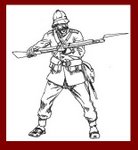
- Bayonets: British regulars openly fixing bayonets before a charge should cause a penalty to the close assault Stand roll for Pathans and Boers.
Organization
Irregulars come in bands of 10-20 figures, with one overall leader. All irregulars will have melée weapons. The proportion with guns will depend upon their nationality:- Pathans--up to 50%
- Zulus--20%
- Ansars--up to 50%
- Fuzzies--10 to 50%
Artillery comes at no more than one artillery piece per platoon, or even less, possibly one per company.
Regulars may change formations, using one action to do so. Formations include March (on roads), Open Order, Square, and Line. Units in Line may take two separate fire actions in an activation, firing front and rear ranks.
Other Changes
The Regimental Sergeant Major has leather lungs and retains a six inch communications range. All other leaders change communication range down to 3 inches. Command reactivations for units outside this range must be passed by a messenger--for the British, this is normally a mounted officer.Detachments must be given specific orders in advance.
Given the ferocity of the natives and their treatment of prisoners, both sides should have a bonus to make Last Stand rolls--especially any French Foreign Legion units.
Monday, March 6, 2017

Thursday, August 11, 2016

World War I French Aircraft


Listing of all aircraft deployed by the nation of France during World War 1 with history text, performance specifications and photograph images.
Saturday, August 6, 2016
World War 1 Italian Military Aircraft (1914-1918)

While joining the Allies only later in the conflict, the Italian commitment against the Central Powers should not be overlooked.
Thursday, August 4, 2016
Sopwith Snipe

The Sopwith 7F.1 Snipe was a British single-seat biplane fighter of the Royal Air Force. It was designed and built by the Sopwith Aviation Company during the First World War, and came into squadron ...
Top speed: 121 mph
Wingspan: 31′ 0″
Length: 19.85′
Weight: 1,314 lbs
Engine type: Rotary engine
First flight: October 1917
Manufacturer: Sopwith Aviation Company
Bristol F. 2B Fighter

The Bristol F.2 Fighter was a British two-seat biplane fighter and reconnaissance aircraft of the First World War developed by the Bristol Aeroplane Company. It is often simply called the Bristol Fighter or popularly the "Brisfit" or "Biff".
Top speed: 123 mph
Wingspan: 39′ 0″
Length: 25.82′
Retired: 1930
Unit cost: 1,350–1,350 GBP (1918)
First flight: September 9, 1916
Manufacturers: Standard Motor Company, Bristol Aeroplane Company

Tuesday, August 2, 2016
Airco DH.4


The Airco DH.4 was a British two-seater biplane of the First World War. It was the first British two seat light day-bomber to have an effective defensive armament. The DH.4 proved a huge success and was often considered the best single-engine bomber of the War. It was flown by a number of famous British and American aces, such as Frederick Cotton and Charles Bartlett.
Macchi M.5

The Macchi M.5 was an Italian single-seat fighter flying boat, designed and built by Nieuport-Macchi at Varese. It was extremely maneuverable and agile and matched the land-based aircraft it had to fight.
The M.5 was operated by five Italian maritime patrol squadrons as a fighter and convoy escort. By the end of World War I, these aircraft were flown by both United States Navy and United States Marine Corps airmen. The three versions of the airplane proposed include the model flown by the Italian ace Domenico Arcidiacono, an American plane flown by Willis B. Haviland and a captured Austrian plane piloted by Friedrich Welker.
The M.5 was operated by five Italian maritime patrol squadrons as a fighter and convoy escort. By the end of World War I, these aircraft were flown by both United States Navy and United States Marine Corps airmen. The three versions of the airplane proposed include the model flown by the Italian ace Domenico Arcidiacono, an American plane flown by Willis B. Haviland and a captured Austrian plane piloted by Friedrich Welker.
Saturday, July 30, 2016
Hannover CL.IIIA (Baur/Von Hengl)


The Hannover CL.III was a German military aircraft of World War I. It was a two-seat multi-role aircraft, primarily used as a ground attack machine.
Like the other Hannover "light-C-class", or "CL" designated aircraft, it included an unusual biplanar tail, allowing for a greater firing arc for the tail gunner. Until the introduction of this model, such tails had only been used on larger aircraft. The Hannover CL.IIIa in WW1 Wings of Glory is presented in versions flown by Rudolf Hager/Otto Weber and Johan Baur/Georg von Hengel, as well a Luftstreitkräfte model.
Like the other Hannover "light-C-class", or "CL" designated aircraft, it included an unusual biplanar tail, allowing for a greater firing arc for the tail gunner. Until the introduction of this model, such tails had only been used on larger aircraft. The Hannover CL.IIIa in WW1 Wings of Glory is presented in versions flown by Rudolf Hager/Otto Weber and Johan Baur/Georg von Hengel, as well a Luftstreitkräfte model.
Hanriot HD.1

The Hanriot HD.1 was a World War I single-seat fighter aircraft, combining clean lines with a light wing loading. Manufactured in France, the HD.1 was supplied to the Belgian and the Italian air forces, and it proved highly successful. It was flown by a number of the famous aces, such as Belgian Willy Coppens and Italians Mario Fucini and Silvio Scaroni.
Sunday, July 17, 2016
British ROYAL AIRCRAFT FACTORY F.E. 2B Fighter
1/100: British ROYAL AIRCRAFT FACTORY F.E. 2B Fighter Aircraft WW I

Hand crafted, picked one up a week ago, very nice!
Friday, July 15, 2016
Wings of Glory: Caproni CA.3

The Caproni Ca.3 was an Italian heavy bomber that saw extensive use against the Central Powers forces. It was a wooden three-engine biplane and one of the most effective bombers of any air force during WWI, heavily armed and deadly with his bombs.
Monday, June 6, 2016
Wargaming for Grown-ups: A Ande-y little play test

Wargaming for Grown-ups: A Ande-y little play test: After a few weeks or so doing other stuff it was time to get back to this year's major project, - the Pacific War of 1879-84. Regular r...
Subscribe to:
Comments (Atom)