The Martians have invaded, time to return the favor!

The Martians have invaded, time to return the favor!
Showing posts with label Uniforms. Show all posts

Tuesday, June 27, 2017

Steampunk Soldiers: Uniforms & Weapons from the Age of Steam (Dark Osprey)


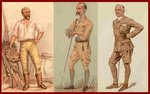
Steampunk Soldiers is a unique pictorial guide to the last great era of bright and colorful uniforms, as well as an important historical study of the variety of steam-powered weaponry and equipment that abounded in the days before the Great War of the Worlds.
Between 1887 and 1895, the British art student Miles Vandercroft travelled around the world, sketching and painting the soldiers of the countries through which he passed. In this age of dramatic technological advancement, Vandercroft was fascinated by how the rise of steam technology at the start of the American Civil War had transformed warfare and the role of the fighting man. This volume collects all of Vandercroft's surviving paintings, along with his associated commentary on the specific military units he encountered.

Saturday, December 12, 2009

Changing Of The Guard


This is the first day of the "changing of the guard Ceremonies" in Halifax Nova Scotia its the 100th Anniversery of British Imperial forces leaving their last operational base and garrison in Halifax, I have and will have allot more pictures, there are and will be hundreds of re-enactors portraying military history both Canadian and British from 1749-present, today there were guys from the famed British re-enactment group "The Die Hards" portraying 1780's Line regiment "Duke of Cambriges own Middlesex regiment"
http://www.militaryphotos.net/forums/showthread.php?t=86421
 

Saturday, July 19, 2008

HaT Industrie 8000 series


Victorian Era

8179 Gatling Gun and Crew*
8180 Nordenfelt Gun and Crew*
8181 British 17th Lancers*
8182 Natal Native Horse*
8191 Zulu Warriors*
8192 Natal Native Contingent*
8193 Egyptian Camelry*
8194 British Camel Corps*
8202 Colonial Highlanders*
8203 Colonial War Indians*
8206 Frontier Light Horse*
8207 Baggage Camels*
8208 Mahdist Camelry*
8209 British Mounted Infantry*
8210 Colonial Artillery*
***************
WWI

8060 WWI Austrian Inf
8061 WWI Russian Inf
8070 WWI Ottoman Inf
8071 WWI ANZAC Inf
8080 WWI Russian Heavy Weapons
8081 WWI Austrian Heavy Weapons
8094 WWI Ottoman Artillery and Machine guns
8109 WWI German Artillery
8110 WWI German Heavy Weapons Set
8111 WWI Canadian Infantry
8112 WWI US Infantry
8113 WWI FT-17 with 37mm cannon
8114 WWI FT-17 with Hotchkiss machine gun
8122 WWI Serbian Infantry
8123 WWI German Colonial Infantry
8148 WWI French Infantry (kepi)*
8153 WWI Australian Light Horse*
8158 WWI US 75mm gun with crew*
8159 WWI French 75mm gun with crew (kepi)*
8161 WWI French 75mm gun with crew (helmet)*
8199 WWI German Jaeger*
8200 WWI German Infantry*
81xx WW1/2 Six horse train and limber*
* Future items.

Sunday, July 13, 2008

Polizeitruppe: Deployment of German Colonial Police Forces, May 1914


The figures shown here are Airfix Japanese infantry, converted
to German East-African Polizei-Askari. The steel helmet has
been carved into a pillbox cap. Other Japanese figures wearing
a field cap with neck flap may be converted in a similar fashion.
The advantage of using the Airfix Japanese figures is that they
already wear the proper type of puttie.

Wednesday, July 9, 2008

U.S. Cavalry Museum Fort Riley, Kansas


Originally called Camp Center, Ft. Riley was established in the 1850s to provide protection to immigrants migrating westward on the Oregon and Sante Fe Trails. Its cavalry units policed the Kansas Territory during the pro and anti-slavery bloodshed that preceded the Civil War and it was the last home of General George Armstrong Custer before he met his fate at the battle of the Little Big Horn. The museum includes exhibits of cavalry activities from their early beginnings in the Revolutionary War up to their modern deployment in the Persian Gulf. It also features the work of outstanding military artists in both oil and bronze.

Tuesday, April 8, 2008

'With the Foreign Legion in Gallipoli'


The author joined the French Foreign Legion in 1914 at the age of fifteen and a half after an adventurous few years at sea. He enlisted at Algiers under the name of Cornelis Jean de Bruin and was sent to Fort St. Therese at Oran and thence to Sidi Bel Abbes, the headquarters of the Legion in Algeria.

http://www.greatwardifferent.com/Great_War/With_the_Foreign_Legion_in_Gallipoli/With_the_Foreign_Legion_in_Gallipoli_01.htm

Legionnaire Sentry


French Foreign Legionnaire on sentry duty in Morocco. Photo by Captain Edouard Juniod
French Foreign Legion Photo by Captain Edouard Juniod, in Morocco.

The French Foreign Legion, maintained a presence in the overseas dominions of France before, during and after the First World War. The Legion changed to a horizon blue and a khaki. Generally in 1915, and after the Legion were clothed in khaki, the trouser were in a sand coloured cotton material. This Legionnaire is wearing the M-1915 double breasted greatcoat, on his left shoulder is the unit citation lanyard, which was introduced in 1916.

He is standing on guard at the French outpost fort in the Atlas mountains in Morocco, he is armed with the M1907/15 Berthia rifle, which is fitted with a cruciform bladed M1893 bayonet with a hooked quillon. The basic rifle equipment is worn would be in a brown leather, being a 1914 pattern, although nearly identical to the pattern of 1903.

The soldier is wearing puttees and interestingly he appears to be wearing some form of native produced foot wear.

Thursday, April 3, 2008

"LA FORCE PUBLIQUE"


"DE OPENBARE WEERMACHT" IN THE BELGIAN CONGO.

A. Organisation (1885-1918).

The term "Force Publique" was officially used for the first time in a paper dated 30th October 1885, whereby King Leopold II drew the outlines for the Congo Freestate. Actually, it was decided that a "departement C" from the Belgian Foreign Office would be responsable for the Force Publique, its artillery, weapons & ammo. However, the text does not indicate how this should be done in practice and did not change the actual situation.

Friday, February 1, 2008

World War I - Trenches on the Web


"Facts are mere accessories to the truth, and we do not invite to our hearth the guest who can only remind us that on such a day we suffered calamity. Still less welcome is he who would make a Roman holiday of our misfortunes. Exaggeration of what was monstrous is quickly recognised as a sign of egotism, and that contrarious symptom of the same disease which pretends that what is accepted as monstrous was really little more than normal is equally unwelcome."

Max Plowman from Subaltern on the Som

http://www.worldwar1.com/index.html

Tuesday, January 29, 2008

Frist World War.Com


This website contains much material based in and around the events of World War One - but if you are unsure how it began and who did what, well, where to begin? That's the purpose of this section of the site.

Admittedly the origins of the war remain somewhat controversial even after all these years, but the facts are there. The articles contained here outline the run-up to the war, who was who, and explain why the assassination of Austrian Archduke Franz Ferdinand was by no means the sole cause of the conflict, how it was spoiling anyhow.

Having read these primers you will hopefully be in a better position to explore the remainder of the site which despite its size is, of course, still very much in development.

Monday, January 28, 2008

History of the Marine Infantry (1675-1919)


The naval infantry troops was as a generic
compound formation from the two Armed
forces of the navy and army. This was
expressed in the fact that they are
weisungsmäßig and belonged to the Navy,
but the operational requirements, and
even the grade designations came from
the army.

Thursday, January 17, 2008

Imperial Japanese Army


The early Imperial Japanese Army was essentially developed with the assistance of French advisors, through the second French Military Mission to Japan (1872-1880), and the third French Military Mission to Japan (1884-1889). However, due to the German victory in the Franco-Prussian War, the Japanese government also relied on Prussia as a model for their army, and hired two German military advisors (Major Jakob Meckel, replaced in 1888 by von Wildenbrück and Captain von Blankenbourg) for the training of the Japanese General Staff from 1886 to April 1890: the Imperial Army General Staff Office, created after the Prussian Generalstab, was established directly under the Emperor in 1878 and was given broad powers for military planning and strategy. Other known foreign military consultants were the Italian Major Pompeo Grillo, who worked at the Osaka foundry from 1884 to 1888, followed by Major Quaratezi from 1889 to 1890, and the Dutch Captain Schermbeck, who worked on improving coastal defenses from 1883 to 1886.

Japan did not use foreign military advisors between 1890 and 1918, until again a French Military Mission to Japan (1918-1919), headed by Commandant Jacques Faure, was requested to assist in the development of the Japanese air services.
Satsuma rebellion

Not surprisingly, the new order led to a series of riots from disgruntled samurai. One of the major riots was the one led by Saigō Takamori, the Satsuma rebellion, which eventually turned into a civil war. This rebellion was put down swiftly by conscripts in the newly- formed imperial army, trained in Western tactics and weapons, even though the core of the new army was actually the Tokyo Police force, consisting mostly of former samurai.

An imperial rescript of 1882 called for unquestioning loyalty to the Emperor by the new armed forces and asserted that commands from superior officers were equivalent to commands from the Emperor himself. Thenceforth, the military existed in an intimate and privileged relationship with the imperial institution. Top-ranking military leaders were given direct access to the Emperor and the authority to transmit his pronouncements directly to the troops. The sympathetic relationship between conscripts and officers, particularly junior officers who were drawn mostly from the peasantry, tended to draw the military closer to the people. In time, most people came to look more for guidance in national matters to military commanders than to political leaders.

By the 1890’s, the Imperial Japanese Army had grown to become the most modern army in Asia, well-trained, well equipped and high in morale. However, it was basically an infantry force which at times was deficient in cavalry and artillery when compared with its European contemporaries.

Wednesday, January 16, 2008

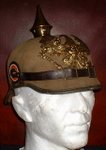
German Colonial Uniforms And Insignia


his website is intended to give an insight
into the uniforms of the Imperial German
Colonial and Overseas Forces from
1884-1918 for the English speaking
wargamer, modeler or military historian.
Until now there has been very little
available in the English language on
the uniforms worn by German forces in
these obscure but fascinating side shows
of the Great War and Colonial Era.


http://www.sacktrick.com/igu/germancolonialuniforms/militaria/militaria.htm

Saturday, December 29, 2007

Uniforms Great War


In the many multi-volumed histories of
the Great War that were published either
in serial form during the war or afterwards,
it was almost traditional that lavish color
plates were included of the uniforms of the
combatants.Naturally one's own side and
nationality were over-emphasized, but even
so the collections could at times be quite a
colorful array of illustrations, featuring
exotic and seldom seen uniforms. That these
displays bore little relation to sartorial
reality on the battlefield was of scant
consequence. The drawings were colorful,
patriotic and inspiring.